WOMEN: THE VOICES OF SURVIVORS IN MILAN, “FREEDOM IS NOT A GIVEN”
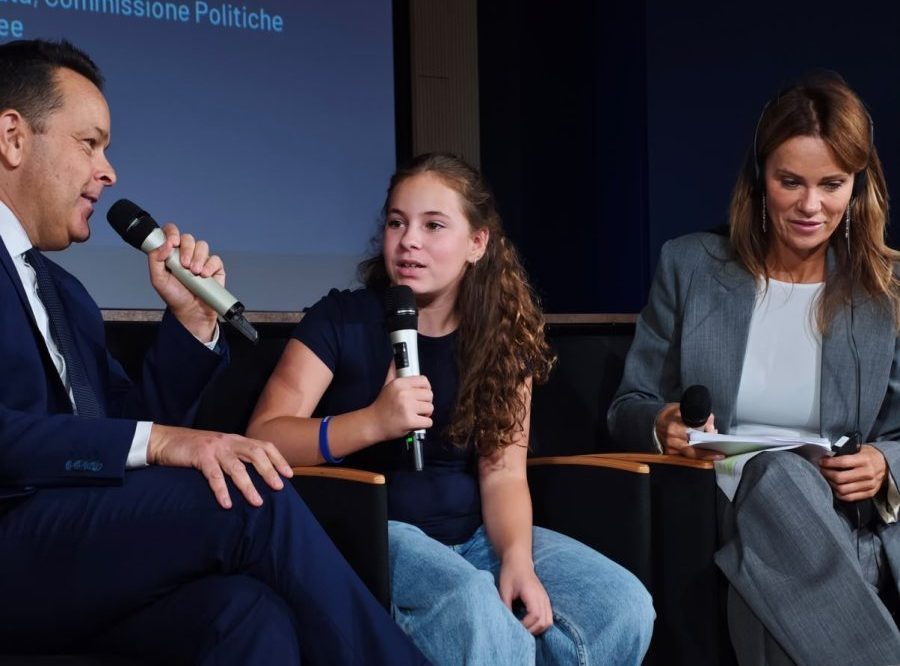
A young girl abducted by Hamas, a Yazidi woman kidnapped by ISIS, a former hostage from 7 October, an Afghan activist and an Iranian dissident. It was above all their testimonies that shaped ‘Women: Freedom Is Always in Fashion’, the conference organised by the Milton Friedman Institute at the Assolombarda Congress Centre during Milan Fashion Week, featuring four panels dedicated to women’s freedom, terrorism, security and the fashion industry’s commitment.
Ela Elyakim, an Israeli and Italian citizen, was eight years old when, on 7 October 2023, she was abducted by Hamas from the Nahal Oz kibbutz along with her sister Dafna. She recounted her 51 days in captivity, spent in various homes and even underground. “They took us to a sort of cage, like a dog’s, only a bit bigger.” When asked by Hoara Borselli where she had found the strength to endure, she replied: “My sister.” Today, she said, “I’m fine. It’s as if I’ve got the worst behind me.”
Fawzia Amin Sido, a Yazidi woman from Sinjar who was abducted by ISIS in 2014 when she was ten years old, recounted how she was separated from her brother, sold, chained, beaten and tortured. In 2020, she was transferred to Gaza where, according to her testimony, she was forced under threat to marry a jihadist and have two children. She was freed after ten years by the IDF. “I am not here to ask for your compassion; I am asking for humanity,” she said. “I just want to be a daughter again – a daughter who can embrace her mother once more.”
Also on stage was Aviva Siegel, who was abducted by Hamas along with her husband Keith on 7 October and held captive for 51 days. She spoke of the hunger, the time spent underground and the control exercised by her captors. When her husband told her he could no longer breathe, she recalled, she thought: “I didn’t want to see him dead. The only thing I could think was: please, let me die first.” Siegel also spoke of Ela Elyakim, who was sitting on her lap whilst the kidnappers told the two little girls that Israel no longer existed and that they would have no home to return to. “Ela couldn’t stop crying.” Aviva hugged Ela just before addressing the audience and was moved to tears.
From Afghanistan came the testimony of Husna Jalal, founder of Women for Change International, who denounced the exclusion of girls from education beyond Year 6 and described the situation of Afghan women as ‘gender apartheid’. “Islamist ideologies know no borders,” she warned. Jalal, who now lives in the Netherlands, also addressed her message to Europe: “We fled our country. Where are we supposed to go now – to Mars?”
Speaking on behalf of Iran was Elaheh Tavakolyan, who began her speech by raising her fist and asking the audience: “Do you see a terrorist?”. She recounted how she had taken to the streets alongside her daughters during the protests and had been struck, losing an eye. “Freedom for Iran,” she chanted. When her daughter asked her why she was demonstrating, she replied: “For freedom. So that you don’t end up like our generation, repressed and forced into silence.” “If I could go back, I’d make the same choice again. I have no regrets whatsoever.”
The proceedings were opened by Dario Peirone, Director-General of the Milton Friedman Institute, followed by Mariofilippo Brambilla di Carpiano, President of the Italy-Iran Association. Among the institutional speakers were Senator Mariastella Gelmini, Senator Elena Murelli, Member of Parliament Alessia Ambrosi, Lombardy Regional Councillors Giulio Gallera, Sergio Gaddi and Marco Bestetti, and Senator Daniela Santanchè. Roberto Bagnasco, Member of Parliament, introduced the first panel by stating that “the fate of Iran belongs solely to its people”. Meanwhile, the Honourable Andrea Orsini recalled the brutality of 7 October. Riccardo Truppo, group leader, spoke on behalf of the local council. The event also received official greetings from numerous ministers, Mayor Sala and Regional President Fontana.
Santanchè described the burqa as a “portable prison” and outlined five priorities: freedom of choice in clothing; combating forced marriages and female genital mutilation; providing refuge for those fleeing Iranian repression; holding to account those who oppress, torture or kill women and children; and engaging the fashion industry to give a voice to women deprived of their rights. “Words are important, but then there’s action,” she said, hugging Ela and Aviva.
The second panel, dedicated to violence against women as a tool of terror on 7 October, was moderated by Mediaset journalist Francesco Vecchi. Ruth Halperin-Kaddari, director of the Rackman Centre at Bar-Ilan University and co-founder of the Dinah Project, outlined the work documenting sexual violence on 7 October and during the hostages’ captivity. A deeply disturbing academic report.
In the third panel, moderated by Emanuela Gentilin, ‘Women and Security: Universal Rights’, Senator Elena Murelli stated that ‘there can be no freedom without security’, whilst also emphasising women’s economic independence. Manel Msalmi, meanwhile, presented the perspective of European Muslims committed to combating Islamist extremism, calling for greater attention to be paid to radical networks and organisations which, according to his remarks, support Hamas.
The fourth panel, moderated by journalist Barbara Politi and preceded by a brief fashion show featuring the ‘Lux’ collection, brought the theme to Milan Fashion Week. Designer Chiara Boni described fashion as a “mirror of the times”, capable of reflecting social change and women’s emancipation. Farnoush Hamidian, a model and actress born in Iran, summed up the day’s message: “There is nothing more precious to a woman than freedom”. Being free, she explained, means being able to laugh in public, dance, feel the wind in your hair and, above all, “having the right to choose what to do, what to be, how to live”. The event featured testimonies never before heard in Italy, whilst the closeness and affection between the speakers – particularly the Israeli and Iranian women – were truly remarkable. All the speakers agreed with the equation put forward by the campaign with which the Friedman Institute took Milan by storm: HAMAS = ISIS = THE TALIBAN = THE IRANIAN REGIME. “The enemies of freedom and of women, whom only Israel is currently standing up to,” emphasised many of the speakers.


Leave a comment