The Munich Consensus Unravels: A Transatlantic Family Meeting in Name Only
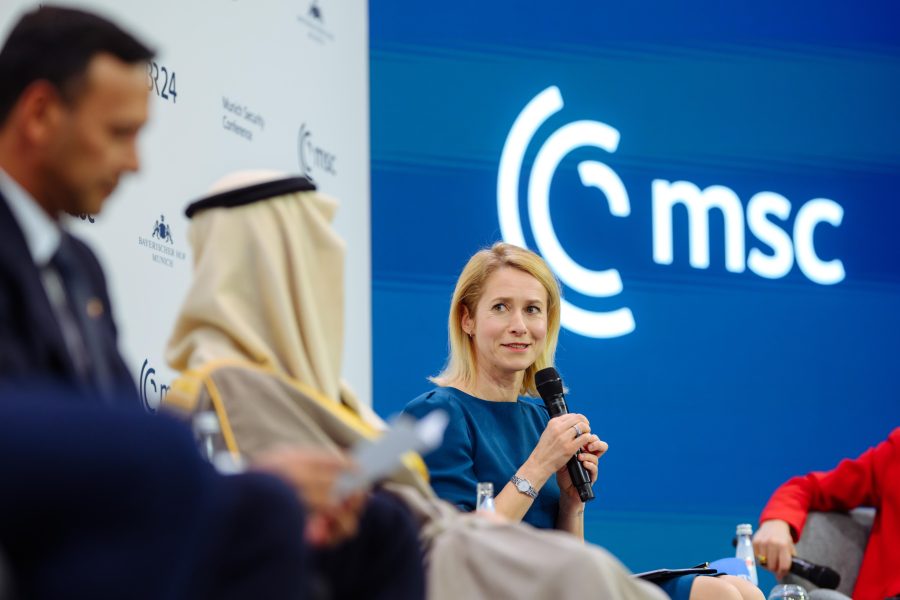 20260213 MSC, Munich Security Conference, Bayerischer Hof - Conference Hall: Kaja Kallas, Prime Minister of Estonia, participates in a panel discussion at the Munich Security Conference, holding a microphone while addressing key global security issues. The backdrop features the MSC logo, emphasizing the event's focus on international cooperation. Photo: Lukas Barth-Tuttas/MSC
For decades, the Munich Security Conference was known as the “transatlantic family meeting,” a yearly ritual where Western allies would smooth over differences and reaffirm a shared vision for the global order. The 62nd iteration, held from February 13-15, 2026, felt less like a family gathering and more like a tense arbitration hearing for a partnership on the rocks. Under the banner of “Under Destruction,” the conference laid bare a Western alliance grappling with fundamental questions about its future, its values, and its ability to confront a cascade of global crises .
With over 1,000 delegates from roughly 120 countries, including nearly 60 heads of state and government, the Bayerischer Hof hotel was as crowded as ever . But behind the packed schedule of panels and bilateral meetings was a palpable sense of unease. The 2026 Munich Security Report set the tone, warning of an era of “wrecking-ball politics” that is eroding the post-World War II international order and sowing deep distrust among traditional allies .
A “Divide” Becomes a Chasm
The central drama of the conference was the state of transatlantic relations. While there were no dramatic walkouts or personal insults, the polished diplomacy could not mask a structural shift. German Chancellor Friedrich Merz, in his opening address, delivered a stark diagnosis, stating plainly that a “divide” has opened up between Europe and the United States, warning that “the transatlantic partnership is no longer something we can just take for granted” .
U.S. Secretary of State Marco Rubio arrived with the largest-ever U.S. delegation, including over a quarter of the U.S. Senate, signaling that Washington still values the forum . However, his message was one of profound change. Rubio called on Europeans to join Washington in addressing what he described as the West’s decline, making it clear the U.S. would not preserve policies that, in its view, have contributed to current global challenges .
While European Commission President Ursula von der Leyen claimed to feel “reassured” after Rubio’s speech, others saw a more troubling reality . EU foreign policy chief Kaja Kallas explicitly rejected the premise of European “decline,” disputing the notion that the continent needs to be “rescued” . German media was less diplomatic, with outlets like Die Zeit noting that while Rubio’s tone was mild, the underlying reality that the U.S. and Europe “are no longer a good fit” was impossible to ignore . Greek public broadcaster ERT’s correspondent summed up the sentiment: “The close relationship that once existed between the two Western blocs no longer exists. We are witnessing the formation of a new kind of transatlantic relationship” .
Ukraine: From Center Stage to a Side Note?
For Ukraine, the conference delivered a dose of sobering reality. President Volodymyr Zelenskyy arrived seeking concrete commitments, but left with largely symbolic support. He was honored with the Ewald von Kleist Award, presented to the Ukrainian people for their “courage, readiness for self-sacrifice, and determination to defend their freedom” . Yet, as German media outlet Der Tagesspiegel lamented, this prize felt like the only tangible result for Kyiv .
Zelenskyy voiced major concerns that Europe was being sidelined in potential peace negotiations, criticizing the lack of European participation in U.S.-mediated talks and urging the EU to set a clear timeline for Ukrainian membership by 2027 . But his pleas for more weapons and a clear path to membership were met with a muted response. Politico reported that European officials did not anticipate “many concrete results” beyond statements of solidarity .
The conference underscored a deadlock in peace efforts. A U.S. official indicated Washington would not finalize a security guarantees agreement with Ukraine until a peace deal with Russia was reached, creating a catch-22 for Kyiv . Der Tagesspiegel’s analysis pointed to four disappointing outcomes for Ukraine: no progress on negotiations, no guarantee of rapid EU accession, no new weapons commitments, and no fundamental shift in Western strategy . As one German foreign policy expert put it, Europe still lacks a unified objective for supporting Ukraine, a gap that left many wondering what the EU and Germany are willing to do militarily to change the dynamics of the war .
The Search for a “Self-Sustained” Europe
In the face of U.S. unpredictability, the concept of European “strategic autonomy” moved from a fringe idea to a central imperative. This was most vividly illustrated by French President Emmanuel Macron’s confirmation that France has initiated strategic consultations with Germany and other European partners on its nuclear deterrence policy—a topic once considered taboo . The dialogue aims to align defense strategies and strengthen Europe’s security framework amid doubts about the long-term viability of U.S. security guarantees.
However, the path to autonomy is fraught with internal division. Spanish Prime Minister Pedro Sánchez pushed back on the nuclear discussion, warning that deterrence carries significant risks and cannot guarantee stability . Meanwhile, von der Leyen pushed for stronger implementation of the EU’s mutual defense clause, backed by a massive €800 billion program to enhance defense readiness by 2030 .
The tension between aspiration and reality was captured by German media. The Berliner Zeitung reported on an awkward moment where Macron repeatedly tried to greet a seemingly oblivious Chancellor Merz during a press conference, a scene the paper used to illustrate a broader point: “France seems like a lame duck, while Germany lacks a clear plan” . This internal dissonance, as analysts from Shanghai International Studies University noted, leaves Europe in a state of being “separated but not divorced, ambiguous but not apart” from the U.S.—dependent on American security but yearning for its own strategic footing .
The New Frontiers: Greenland, Resources, and Geospatial AI
Beyond the traditional geopolitics, new and emerging issues took center stage. The conference saw a heated discussion on the Arctic, specifically regarding Greenland. Danish Prime Minister Mette Frederiksen firmly stated that Denmark would not compromise its territorial integrity in the face of renewed U.S. interest in the island, though she left the door open for a potential expanded American military presence under NATO auspices .
The geopolitics of resources was another key theme. A panel titled “Raw Power” discussed the battle for critical minerals and energy corridors, a conversation that Secretary Rubio framed as central to a revitalized transatlantic alliance .
Interestingly, a key takeaway from the corporate world was the emergence of geospatial intelligence as a critical capability for national security. Johanna von der Leyen, CEO of geospatial AI company PangeAI, noted in a post-conference analysis that the push for “strategic autonomy” is fundamentally a geospatial problem. Europe’s desire to know things independently—from Russian troop movements to the vulnerability of its energy infrastructure—requires a robust, AI-powered satellite intelligence layer . With Germany committing €35 billion to space security and the EU’s IRIS² satellite constellation in development, the message was clear: in the 21st century, security is as much about data from space as it is about troops on the ground .
The Sound of Silence
Perhaps the most poignant commentary on the conference came from the streets of Munich. Organizers prepared for a record number of demonstrations, and protesters delivered a powerful counter-narrative to the high-level discussions inside the Bayerischer Hof .
Under the slogan “ZeuS – War or Peace?”, thousands demonstrated against the very premise of the conference’s solutions. They carried signs declaring “Money for welfare, not for weapons” and “negotiate instead of shooting” . Protesters accused the MSC of becoming a platform for “fuelling war,” arguing that the focus on rearmament and deterrence only leads to escalation. “Expanding the military has never brought peace,” one demonstrator told Chinese media, “only an arms race and huge risks of war” .
This stark divide between the official security narrative of rearmament and the public’s demand for diplomacy highlighted a growing societal fissure within Europe itself.
As the 62nd Munich Security Conference drew to a close, it left more questions than answers. The “family meeting” did not end in a public brawl, but it did confirm a silent, structural shift. The post-war order, as Chancellor Merz noted, “no longer exists” . The task now for European leaders is not just to manage their relationship with Washington, but to navigate a world where they can no longer be certain of its direction—all while listening to the voices of their own citizens who are deeply skeptical of the path ahead.
 Brussels Diplomatic
You must be logged in to post a comment.