IMMIGRANTS: NOT AN EMERGENCY BUT THE FUTURE OF EUROPE
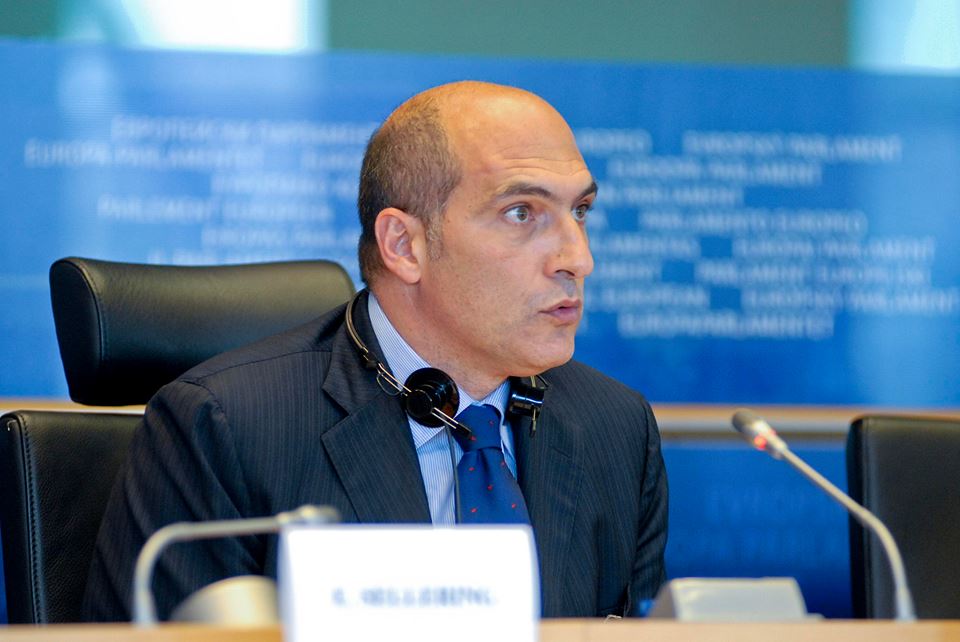
MEP COZZOLINO
Andrea Cozzolino (Naples, August 3, 1962) is an Italian politician. From 7th June 2009 Member of the European Parliament (S&D Group- Deputy Chief of the Delegation of Democratic Party). Following his point of view based on his experience about immigration, public funds and employment strategies.
Migration is actually seen it as an emergency but actually it’s a resource not a problem. Europe needs to react with a politics of integration because migration will be a fact that will involve Europe for the next 20, 30 years. At the moment in Europe, we do too much care about supervise the costs and not about having a full politics of Europe.
In the next 30 years Europe will have a strong decrease of demographic data and to increase it we need to focus on integration. We have to focus on a policy of attraction of brains and not only hands. The changing of prospective facing migration is important, seeing it as a potential which will accompany Europe for the next years coming. Europe has one of the poorest birth rate and the present of old people is one of the most increased data. If we want to keep the same tenor of life, of consume, of welfare, we have to make them more sustainable. Especially in the Mediterranean area is needed a different political approach based on attraction. USA could be considered an example, it attract the best young Indians and Pakistan brains who are developing the luxury technological feature of USA; Today the improvement of the economic and knowledge system of USA is based on this strategy.
Italy is one of the lands were immigrants come but not the biggest. If in Italy 100 immigrants come every day , it means that in Spain , Greece and Balkans millions of immigrants come. It is also true that the sea makes many tragedies and this is not helping to see the fact less problematic.
We are not a country , but we are a European frontier. In the south of Italy, in Rosarno (Calabria), there has been one significant experience which at the beginning was a conflict but then it was the push to build up something important for what is related to workers’ rights and social inclusion policy. The spirit was to “use” hands and not to “abuse” of them. There is a big problem with the desolation of villages situated in mountains in the south of Italy, so social inclusion and integration of immigrants could be considered in this case a strategy to repopulate the territory , to build up a common base and to develop the community. Still in Calabria many towns are adopting this approach. Also universities are using this approach to have a cultural development, this could be considered as one of the methods to attract brains to our country. Italy needs at the same time a policy which goes against humans traffic, against organized crime, against the captains of these “boats of death”.
Europe needs a new feature prospective, a prospective which give a value to employment, referring on it as a rights and to think at them as a common resource. There is not only the market of work to take care about but also to change the economic policy. Things needs to change step by step. A more efficient regulation talking about work as a market must be based on a common low where a Polish , Italian , Spanish worker have the same rights where ever they go working. Europe has the necessity to be united and to build a net of support based on shared rights and principles.
The structural funds were used to cover the crisis, in some cases wasted and in some other cases to support those minimal forms of care for who just went out from an industrial crises and market crises. Those funds were used for an area of unemployed and for an old generation , taking out from all the initiatives all of the new generation of young. Taking the example of Italy, it has used the funds to cover the “Cassa Integrazione” (unemployment insurance) , that needs to be covered anyway but at the same time Italy forgot the real goal of the structural funds; so instead of using them to increase the country and investing in the feature of the new generation, those funds were used to supply the lacks of the national policy.
We have to change the “direction” of the policy, we must do it in many areas: we are doing this in the fish and agriculture area thru European policy, procedures that give the chance to bring those “jobs” to younger generation. For example in Italy we are introducing this new law where under 30 years old you can be hired inside a company and you can be directly trained to activity like fishing. It’s a traineeship with a salary of 2 years if you are under 30.
It is necessary to a reform which support a procedure which underline the necessity to have the professional directly inside the company not outside in a separate place.
The use of more automatic procedure guarantee a number of long months working based (minimum 36 months) in training , with the possibility to change this contract into undetermined; the importance of having the training inside the company underline the importance of the work, of the routine of the work, so to take habitude to wake up in the morning, go to badge and to respect time table and shifts.
We are trying to find an agreement with the Italian regions to have minimum 400 euro a month for 36 months, which will break the cost for the company; the companies in exchange have to take youth from 18 till 35. During this 36 months the relation between the worker and the company will be direct and stronger (the company will have to provide with staff specialized in tutorial and training), and if the contract will change into indeterminate the company will receive a contribute from the funds to help them to keep the same level. The young between 18-35 years today are less protected, and if we have a look at the situation in Italy we haven’t got an universal size, no protection for who doesn’t have a job. We risk to have a young generation without any work experience for long time, an effective action is needed.
A part of the European Social Fund (12 billion) , 4,5 billion could be used for this target of young to make this type of contracts.
The MEP Cozzolino said: “ If we use 4,5 billion to do those kind of contract we can guarantee at 250 thousand of young in the south Italy area between 18-35 a concrete experience of work with a high level of quality. Italy could become more competitive at European level. Also in public administration offices it’s needed a younger generation, procedures will become more moderns and faster. The experience of someone who work in an office from ten years with the fresh brain of a young who looks forward to learn” is the perfect combination to make automatically the step from “old to new”.
Piera D’Arrigo
 Brussels Diplomatic
You must be logged in to post a comment.