Between Laws, Peoples and Forests: The Role of Law in Building a New Global Consciousness at COP30
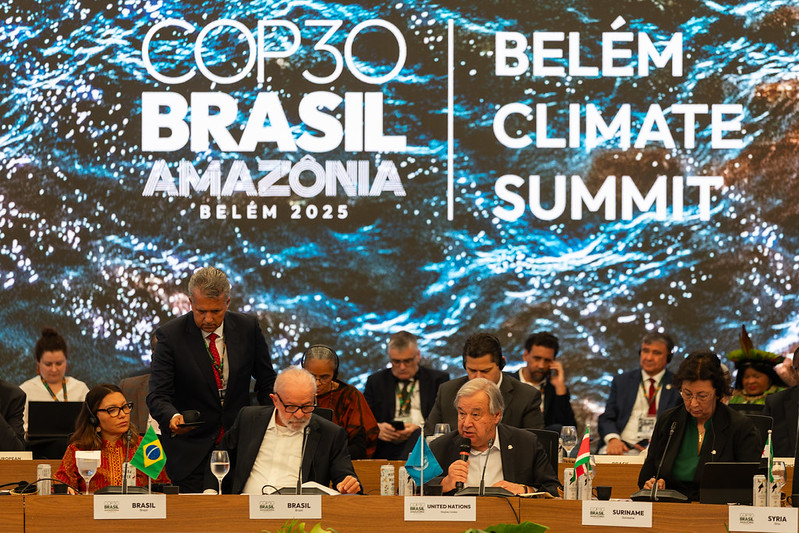
Brazilian President Luiz Inácio Lula da Silva and UN Secretary-General António Guterres attend Thematic Session 2: The Energy Transition at the Belém Climate Summit. (Photo: © UN Climate Change – Kiara Worth)
At the crossroads between environmental collapse and legal responsibility, a new paradigm emerges: the law as guardian of the Earth and mediator between human progress and the preservation of the planet.
Belém, on the banks of the world’s largest river, will become the epicentre of humanity’s most urgent discussions this November. COP30 is not just an environmental conference; it is a historic milestone that redefines the concept of planetary justice. What is at stake is no longer a political or ideological issue, but the survival of basic living conditions on the planet.
As a legal professional, I observe with deep concern and hope the way in which the legal sphere is beginning to occupy its rightful place in this debate. For a long time, the law was treated as a mere spectator of the environmental crisis, an instrument of belated punishment, limited to reacting to damage already done. Today, it needs to be much more: a protagonist, guide and guarantor of a civilising pact that places nature at the centre of legal protection.
Recognising nature as a subject of rights is not a utopia, but a logical evolution of contemporary justice. If for centuries the law was constructed to protect man from man, now it needs to protect man from himself. The forest, the rivers, the air we breathe and the soil that sustains us are integral parts of the same community of destiny. Legislating without considering this is legislating in a vacuum.
Belém, with its symbolic and spiritual strength, offers a stage for reconciliation between peoples and knowledge. It is where Western law, often rigid and hierarchical, meets indigenous and community worldviews, which for millennia have understood what modern constitutions are only beginning to recognise: that balance is the supreme law of life.
The role of lawyers at COP30 is therefore to rebuild bridges between science and ethics, between economics and humanity. Discussions on climate responsibility, compensation and territorial sovereignty take on a new dimension when viewed from a legal perspective: that there are no longer any possible boundaries for a problem that is planetary in nature.
International environmental governance must cease to be merely a set of political commitments and become a true regulatory body, capable of holding states, corporations and individuals accountable. The creation of climate tribunals, the expansion of access to environmental justice and the classification of ecological crimes as offences against humanity are steps that global law can no longer postpone.
However, the most profound transformation will not come solely from treaties or resolutions. It will come from the legal awareness that each society is capable of building from the perception that caring for the Earth is exercising the most basic of human rights. COP30 represents this call: to make the law not only a tool of order, but an act of lucid love and responsibility for the future.
While leaders negotiate goals and deadlines, there is another silent conference taking place within every jurist, legislator, and citizen who understands the power of the law to protect what remains. Between laws and forests, a new kind of justice is flourishing: a justice that speaks the language of the planet.
‘The work counts on the collaboration of Brusselsdiplomatic international magazine based in Brussels. Its commitment to dialogue between cultures and areas of knowledge reinforces the proposal of this analysis, which is to unite legal and environmental perspectives under a European perspective.’
Maya Nascimento is a legal researcher and analyst, with a background in criminology, psychoanalysis, and psychopathology.
She is a translator and contributor to Brussels Diplomatic, focusing on law and critical analysis of social and institutional relations.
Languages: English, Italian

 Brussels Diplomatic
You must be logged in to post a comment.