‘The Aural Sea’, Uzbekistan’s pavillion at Biennale di Venezia Art
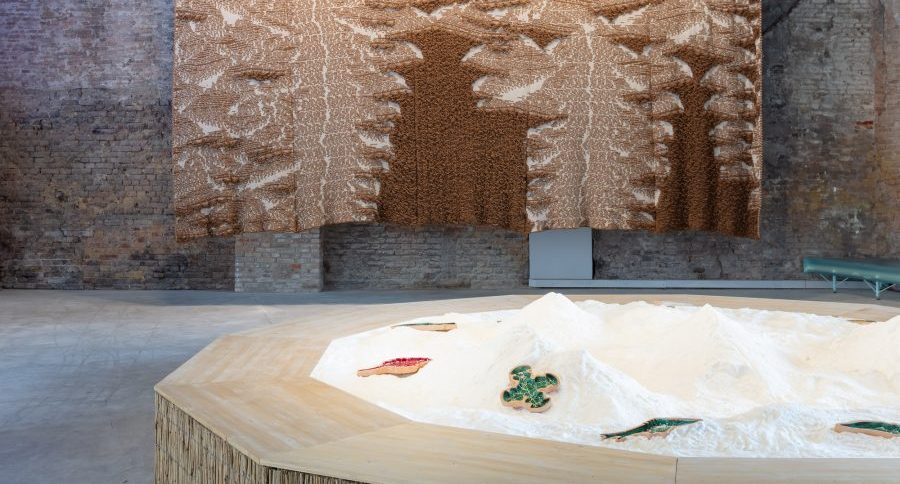
The exhibition reimagines the Aral Sea through myth, storytelling and collective imagination.
The Pavilion turns to mythmaking and storytelling as ways of responding to environmental transformation – and of learning from the Aral Sea region of Karakalpakstan, Uzbekistan. Stretching across northwestern Uzbekistan, the Aral Sea was once one of the world’s largest inland lakes, before large-scale diversion of the region’s rivers for agricultural irrigation turned it into a desert in the 1960s. Yet for the local population of Karakalpakstan, south of the Sea, the region remains not simply a story of disappearance, but a place where hope and imagination persist, held in memory, story, and everyday life.
Interview with Ambassador to the Italian Republic Abat Fayzullaev
Reflecting this outlook, the Pavilion turns to the creation of new myths to imagine futures beyond loss. It takes inspiration from the work of the young Karakalpak author Allyar Darmenov, who began writing about the Aral Sea in 2015, drawing upon realms
of mythmaking to imagine possible futures rather than chronicling environmental devastation, embracing fiction as a way to shift perspective and open new ways of seeing.
The exhibition features newly commissioned and recent works by Jahongir Bobokulov (Uzbekistan), Zi Kakhramonova (Uzbekistan), Aygul Sarsen (Karakalpakstan, Uzbekistan), Zulfiya Spowart (Uzbekistan), Xin Liu (China), A.A.Murakami (UK and Japan), and Nguyen Phuong Linh (Vietnam).
Here, the presence and absence of water is not only a modern condition but a long temporal structure that continues to shape how communities live, remember, and imagine. Fishermen have told stories of glimpsing ruined cities on the lakebed; such moments became the seeds of new legends, binding past and future in a single image.
In her installation Qi, Nguyen Phuong Linh into the flows of energy that circulate around the seabed, the remnant waters, and the atmosphere. Composed of three works, each with motorized components that rise and fall like lungs, or contract like a heart, Qi imagines the landscape as a body whose organs are evolving, in real time, to live in a changing Aral. Colour-graded photographs of the Aral landscape are printed on PVC sheets, resembling translucent skins that reveal the body’s interior. The installation extends Linh’s long-term inquiries into the connections between bodies and geographies, and in particular her field research on salt farms.
Xin Liu’s The Permanent and the Insatiable: Born to Sea (2026) are made from hand woven post-consumer plastic (PET bottles) and submerged in tanks containing an enzymatic solution. Activated by heat, the reaction gradually breaks down the material
over the course of the biennale. Liu’s sculptures resemble both industrial and organic forms: the substructure of machinery or the skeleton of a disappeared organism. Examining the afterlives of materials and infrastructures left in the wake of the vanished sea, Liu’s work offers a speculative and practical model to think through impossible scenarios.
Aygul Sarsen grew up a few hundred kilometres from the former Aral shoreline. Never having seen the water herself, Sarsen turns to portraiture to imagine the Aral as a feminine deity. Her sketches, in quick lines and expressive brushstrokes, capture various Karakalpak imaginaries of the water, personified as hybrid beings with wings, fins, or tree branches for hair.
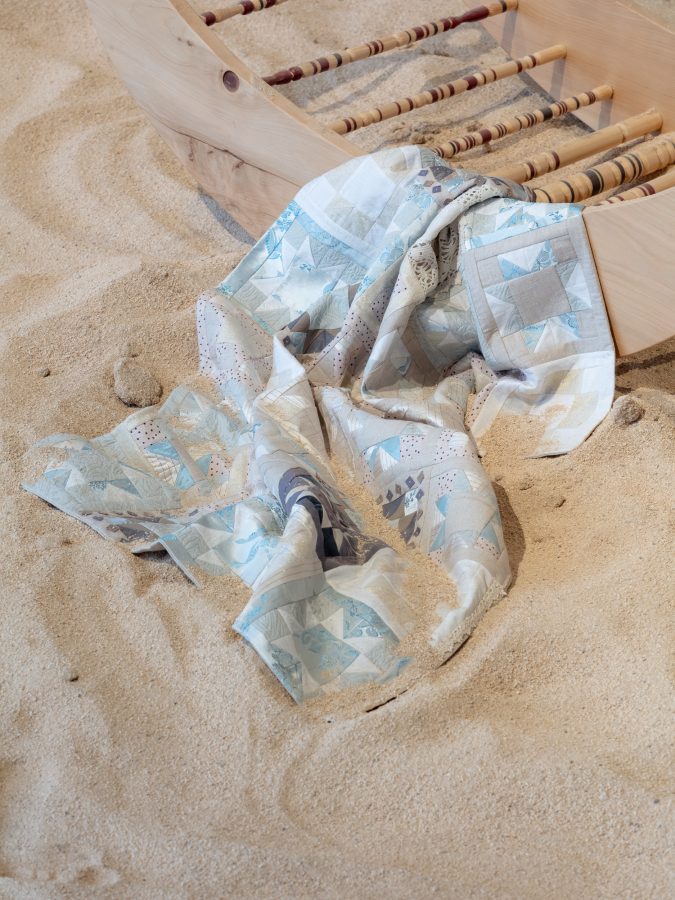
Zulfiya Spowart’s Beshik (The Cradle) (2026) is a sculptural meditation on motherhood, fragility, and adaptation centred on the traditional Central Asian cradle. The installation uses wood, textiles, sound and movement to reflect on the cradle as a “first home,” where tenderness and instability coexist, mirroring the disorientation and redirection caused by the disappearance of the Aral Sea.
Turning to the lost and changing marine life of the Aral Sea, Zi Kakhramonova’s Archive of Lost Forms (2026) is a salt-based participatory installation where viewers physically recreate lost marine life through touch and play. Nearby, A.A.Murakami’s The Sun Sets in a Shell (2026), produced with the support of Mandarin Knitting Technology and Zegna Baruffa Lane Borgosesia, is a large-scale tapestry, capturing environmental transformation through the coded patterns of the zebra mussels—a species native to the Aral Sea—to explore how nature transforms disorder into pattern. These natural mutations in the shell’s pattern, caused by changes in temperature, salinity, acidity, and calcium levels, turn the mussels into time capsules of different points in the sea’s history.
Jahongir Bobokulov’s Aura (2025) is a contemplative work that engages the unseen atmospheres of the Aral region – its emotional residue, spiritual presence, and the invisible forces that continue to shape memory and landscape long after physical disappearance. Using a custom technique of airbrush painting onto polyurethane foam, the composition appears like a source of light that seems to vibrate with energy.
Uniting all the artworks is a new myth written by young Karakalpak writer Allayar Darmenov in the exhibition catalogue. Titled The Labyrinth, it tells the story of the Aral Sea through the voices of salt, sun, shells, breath, creatures, and the Aral Goddess herself. Creating a shared universe through which the exhibition unfolds, each chapter
corresponds to an artwork, forming a constellation of interconnected narratives.
In resonance with the 2026 Biennale theme In Minor Keys, conceived by the late curator Koyo Kouoh as an “archipelago of oases,” Uzbekistan’s Pavilion offers an invitation to listen to the stories held in salt, wind, and inherited memory, and to consider how these voices shape possible futures.
Henry Borzi
 Brussels Diplomatic
You must be logged in to post a comment.