Informal meeting of Foreign Affairs Ministers (Gymnich) on 03 February 2024 in Brussels

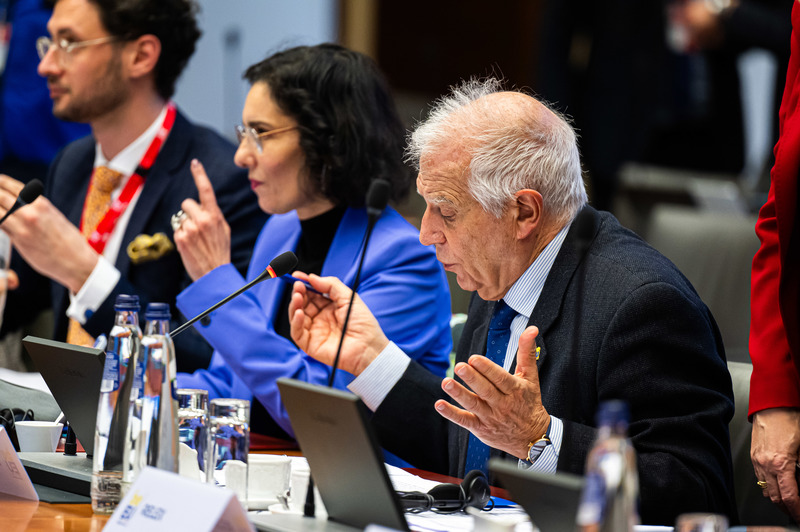
This year, the Belgian EU Presidency organized a Gymnich meeting on February 3rd. This informal meeting of the Council of Foreign Ministers has celebrated its 50th anniversary this year and is named after Gymnich Castle in Germany, where the first informal meeting of the Council took place in 1974. The informal nature of the Council is mainly expressed through the relative isolation in which the Ministers can exchange views on various topics. This allows them to speak openly about topics that go beyond the current news, without advisors, in an atmosphere of confidentiality.
This year, the Gymnich started on February 2nd with a dinner at the Africa Museum, in the presence of the ASEAN ministers. Belgian author David Van Reybrouck and Belgian musician Alice on the Roof have stimulated the guests’ minds and ears during the meal. The dinner was an invitation only event, the press having not been invited. The next day, the ministers moved to the stately Egmont Palace, where they discussed, in the morning, the relations between the EU and Africa in a context of growing challenges. The Belgian EU Presidency wants to build on the conclusions of the EU-Africa Summit that took place in February 2022 to underscore the need for dialogue, cooperation, and engagement in the light of ever-growing geopolitical challenges.

Africa is facing a deteriorating security situation, pressure on constitutional rights, stagnating socio- economic development, and a worrying impact of climate change. The Belgian Presidency wants the EU to further consider how to better understand African ambitions and vision and take steps forward for better representation in multilateral fora. On the other hand, the question arises of how the EU can better fulfil its commitments and meet the expectations of African partners. This undoubtedly includes a better mobilization of EU resources to make the necessary contributions to fight crises and increase stability.
In the afternoon, the ministers discussed EU-Türkiye relations. Following the Joint Communication of November 29th on the political, economic, and trade relations between the EU and Türkiye, the meeting focusing on the various regional developments. The EU will review the extent to which cooperation is possible in the field of foreign policy and security. Specific attention will be paid to democratic reforms, stability, and security in the Eastern Mediterranean and Cyprus.
Preliminary remarks by Josep BORRELL, EU High Representative for Foreign Affairs and
Security Policy
It’s Saturday evening almost and everybody must be tired of this long week where we went from Defence Ministers Council, then EUCO, then Southeast Asia, Indo Pacific, ASEAN and now Gymnich. It has been a meeting on Gymnich spirit. Gymnich spirit means no tie and open and frank exchanges between ministers in an informal setting, discussing in dept things in which we must concentrate our political discussion. We started handling our relations with Africa and we just finished on Turkey.
We discussed our approach to the Russia aggression against Ukraine and we had a debate on the situation in Gaza in general and on UNRA funding in particular. This was not a formal Foreign Affairs Council, so there are not formal conclusions, and I will only be saying what I think the discussion has been about and will ask my Belgium colleague, President of the Council, to help me trying to summarise what we have been discussing. On Africa, you know, you cannot talk about Africa like this. No, Africa is too big and too varied to say Africa, but we have been discussing the continent as a geopolitical priority, our absolute determination to increase our dialogue and cooperation. We arepe nding a meeting at the ministerial level, and we will support Africa quest for a greater representation in multilateral fora, but I cannot summarise a long discussion about Africa done under several points of view; I only say that we must increase our interaction and partnership with Africa with a stronger coordination among us.

On Gaza, you know that the European Council discussed the situation in the Middle East, with no conclusion. Today we discussed very lively, because they are different positions among Member States, about the situation in Gaza and in the region, the catastrophic humanitarian situation. But this catastrophic humanitarian situation is not because it has been an earthquake or has been a natural catastrophe, it’s a man-made catastrophe. The war has pushed hundreds of thousands of people to the South of Gaza. And now that they are in the South, the South continues being bombed and this bombing continues creating a very dire humanitarian situation.
We discussed the issue of financing of UNRA, in the light of the allegations against some of their staff. Member States welcome the measures taken quickly by UNRA to launch an investigation, showing how seriously the United Nations takes this issue, and certainly we expect that an audit will be carried on swiftly and effectively. We want to know more about how UNRA is working and that’s why I have invited the General Commissioner of UNRA, Philippe Lazzarini, with whom I am in permanent contact, to attend the next meeting of the foreign affairs ministers of the Council on the 12th of February to exchange with him about all the aspects related with this issue.
Let me make one thing clear. The Commission, when we say the European Union we mean the Commission of the European Union, has not suspended its funding. Some days ago, it was a kind of snowballs saying that, as Member States are suspending the financing of UNRA, we have to suspend it also. There are a lot of fake news, a lot of misinformation. Germany has not suspended, France has not suspended, Spain has not suspended. Some Member States has suspended but very few has clearly suspended. Others have just been taking precautionary measures, waiting to see, but not stopping payments. And this is the case of the Commission that has not stopped payments, among other things because the next payment is due by the end of the month.
So, you cannot suspend something that you’re not moving. Let’s see, from now until the end of the month where we are. Certainly, we will ask for review, we will ask for control with a look for accountability, but I can say that for the majority of Member States the general feeling is that there is no substitute for UNRA. I repeat, there is no substitute for UNRA. UNRA has been playing a critical role to support the Palestinian refugees and not only in Gaza.
People talk about UNRA as it was only an agency for Gaza. There are hundreds of thousands of Palestinian refugees in Lebanon and Jordany, as well in the West Bank and UNRA is also in charge of these people. UNRA is feeding 2 million people, providing 30,000 medical assistance per day, providing scholarship to more than 400,000 people. Who can substitute that overnight? UNRA is playing a critical role. It’s true that the Israeli government has been a very critical ruler not only now, but from many years ago, but we cannot punish 2 million people by depriving them from the support that UNRA is providing. Who will take care of that? That’s what we discussed at the European Council, and here I think that most of the Member States that participated in the debate, we are very clear about that, we have to look for accountability, we have to look for verification of the allegations, which are serious, but they affect a small number of the 13,000 staff of UNRA in Gaza and, in the meantime, some Member States’ representatives said: not only we are not stopping, but we are increasing the support to UNRA. So once again there is a variety of positions among Member States, but the general feeling is that the support to the Palestinian people has to continue. We talk about the lives of millions of people.
As I said, I invited Philippe Lazzarini, we discussed about the absolute urgency to avoid regional escalation and about the importance of finally liberating the hostages unconditionally, as we always do. On Ukraine, substantial discussion about the military assistance, our unity, looking for a peaceful future for Ukraine and Ukrainian people. We discussed about the situation in the battlefield, the situation on military supplies, the Ukrainian Assistance Fund that I hope will be agreed on the next days inside the European Peace Facility. Our position remains firm. Ukraine needs more and quicker support. The support must come now, and the Ukrainian victory is crucial not only for Ukraine, but for the peace and stability in Europe.
Finally, on Turkey, after a long pause, we brought the topic of our relations back on the agenda. I think that we must call for a closer cooperation between the EU and Turkey, avoid confrontation and increase cooperation. For that we must reach out with Turkey, taken into account the Cyprus issue. We discussed the situation or opportunities in the area of foreign policy, and the conclusion is that we need to engage more with Turkey and work in areas where our interests converge and avoid irritancy among us. This has been a summary of a very intense debate, an intense political debate, because time requires such kind of meetings.
Preliminary remarks by Hadja LAHBIB, Minister of Foreign Affairs, European Affairs and Foreign Trade and Federal Cultural Institutions of Belgium
Hello, good morning. It’s a very special day today because it has been 50 years since the EU ministers of foreign affairs had a meeting in Gymnich, a city near Cologne, where the name of this informal meeting comes from and actually, we really appreciate this format because you know that diplomacy is about discussion, about dialogue and when we can talk in a more informal way, it really helps. And so, we have a certain range of important topics on the agenda: Africa, Middle East, Ukraine and Turkey. African countries are more than neighbours, they are real partners, and we have to explore how we can reinforce our cooperation to share a vision as we are facing the same challenging times when it comes to energy transition, new digital transition and when it comes to migration, instability in the Sahel for instance. And also, we are going to talk about Turkey. Turkey is an important partner within NATO for instance and Turkey has played an important role in the recent conflict when it comes to the Middle East, but also and especially when it comes to the Russian aggression against Ukraine.
The Gymnich is a very important meeting as it allows us to address crucial themes of the moment, the wars that concern us, in a more informal manner, detached from our mobile phones and our speaking points, as they are called in diplomatic jargon. And we have many themes, topics on the agenda, starting with the African continent, which is one of the priorities of our Belgian presidency of the Council of the European Union. We wanted to place Africa on the agenda because it is more than a partner. Today, it is an essential partner in all the challenges we must overcome, which we must face today, be it the digital transition, the need to diversify our production chains, rare materials, instability, or migration. So, it’s a very important partner, and we will explore a little the common visions that we can develop with the 27 to forge new links with Africa.
Then, we will talk about Turkey, which has shown that it can play an essential role as a mediator, among other things with cereals coming from Ukraine. You know that the situation is a bit blocked for now, but we must also consider how we can restart the dialogue. And also, yes, the Middle East, with the increasingly alarming humanitarian situation in Gaza. As you know, the position we defend is to demand an immediate ceasefire, respect for humanitarian access, and then, of course, the release of hostages and the return to the negotiating table to restart political dialogue and reach a two-state solution. We will also talk about Ukraine, for which we have finally reached an agreement, and it is a very good thing that we have reached a long-term agreement with the 27 to release the 50 billion and achieve humanitarian, military, and political aid in the long term for Ukraine. There you go, I might answer your questions now.

Questions and answers
Unidentified journalist
But I do live in Brussels, so maybe that helps.
A question for both of you.
High Representative: you mentioned the absolute urgency of avoiding a regional escalation. Given that the United States carried out air strikes overnight in Iraq and Syria on more than 85 targets, reportedly killing nearly 40 people, do you regard that as an escalation? And how dangerous a step do you see that? And did the ministers around the table have a view on that?
Thank you.
Mr Borrell
Well, it was expected that the US was going to retaliate, to answer to the attacks that they have suffered recently with I think four soldiers killed and many more wounded. It was expected, it was even announced the continuation of these attacks. Certainly, every attack contribute to the escalation and the ministers has expressed a serious concern for this process.
But we only can call everybody to understand that at any moment on this series of attacks and counter attacks a spark can produce a greater incident. And we take our part on trying to avoid it by launching this Navy mission in the Red Sea, which I hope will be approved for the next Foreign Affairs Council in a couple of weeks. And it can be deployed immediately because we have enough Navy assets to launch it immediately. And in the meantime, since we don’t have a military presence in the ground, the only thing that we can do is to try to use our diplomatic capacity in order to avoid this kind of increasing level of action-reaction.
Ms Hadja Lahbib
Yes, I agree with Josef. It’s clear that it was announced, it was what we feared, what we denounced, and that’s why we had called for de-escalation several times. It also underscores the importance of speaking with one voice. So, when I say that we are increasingly converging within the 27 towards a common position, it’s a positive point because beyond even a common position with the 27, it was also discussed today about the importance of having a common position also with the United States and with the United Kingdom, which are involved in this defence in the Red Sea. Belgium is one of the countries that has announced its participation because it’s important to mark its presence, otherwise, it opens the way to escalation. The fact that some also use the current conflict in Gaza to prevent ships from moving, to undermine freedom of navigation, so yes, more than ever, we need to activate diplomatic leverage to avoid an escalation that would drag the entire region into conflict.
Alexandra, Dutsche Wella
Thank you so much. Also, a question on the Middle East. Every time we have a meeting like that, and we have a new development in the Middle East, I’m being asked on air what the European Union can do to contribute to ending the Israel Hamas war Thank you.
Mr Borrell
I would like to have the capacity to end the war. First, the European Union is not on a state, is a group of states and, as you know, they have different approaches to this war. We have a minimum ground. Everybody agrees on the need of humanitarian aid and the increase of humanitarian support of the people affected by the war. That’s a minimum agreement among member states. But when it comes the moment to vote in the United Nations, some people ask for a ceasefire, an immediate and permanent ceasefire, some states ask for it, others vote against, and others abstain. So, it’s very difficult to play an important role if you have inside the club such different positions. And today in our discussion it has been clear that some member states consider that an immediate ceasefire as necessary, others they still don’t see this necessity because they consider that Israel has to continue fighting Hamas and the discussion has been, as the Minister has said, approaching to a position closer to ask for a cessation of hostilities.
Ms Hadja Lahbib
Yes, and the keyword, by the way, is rationalism and international order. There is only one international law, one international order that we have to respect, so there are no double standards.
Mr Borrell
What we can do is what we do. The ministers, many ministers have been travelling to Middle East. Today the French minister was travelling to Israel. Others have gone. There is a lot of diplomatic activity, a lot of humanitarian support to the people in Gaza. We are now discussing our position with respect to UNRA, where, as I said, there are also different approaches. Some say, OK, that’s a moment to increase our support to UNRA, not to cancel but to increase. And others say I am going to think twice before continuing the support.
Another says: yes, I will continue the support, but I wait until there is a clear understanding of the situation.
In general terms, the position of the European Union and Member States is to put pressure on Israel to obey by international law, because one thing is to say that international law has to be respected and another thing is that the international law is effectively respected. And on that also there are different approaches.
Irini Greek TV
It’s on Turkey and I would like to ask if 2024 will keep being a testing year for Turkey or the steps made till now are enough for more progress even regarding the visa liberalisation.
Thank you.
Mr Borrell
Well, as I said, everybody agrees in saying that we have to go to a strong engagement with Turkey to avoid confrontation and increase cooperation, but this will depend on the evolution of facts. What is clear is that we must engage more with Turkey. If we want to avoid confrontation and to increase cooperation, we have to engage more. I don’t know exactly what’s going to happen with the visa and other particular issues that has not been discussed today, but the general feeling is that in order even to solve the Cyprus question, which is for us, as Cyprus is member of the European Union, very high important in our agenda, we have to engage more with Turkey in a positive manner.
Ms Hadja Lahbib
Yeah, and we are going to invite Turkey to celebrate the 20th anniversary of the big enlargement of the European Union in April and we will also discuss, Ce sera occasion de faire le point sur les acquis du premier big bang de l’élargissement avec les 20 qui nous ont rejoint en 2004.
Mr Borrell
« Déjà 20 ans ?! »
Ms Hadja Lahbib
Yes, and it’s Saturday, and in April, we are preparing an event to celebrate the 10th anniversary of the big enlargement of 2004, the 20th anniversary of the big enlargement with the 10 countries that joined us at the time, and the candidate countries will be invited, and Turkey is a candidate country.
Mario Parrot
 Brussels Diplomatic
You must be logged in to post a comment.