Ethiopia : land of wonders and discovery #ethiopia #tourism #business
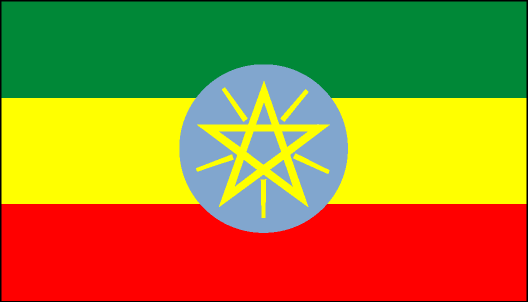
Second most populated country in Africa (over 85 million), and relatively stable country in the Horn of Africa, Ethiopia has experienced in recent years, an annual growth close to 10%, or the one of the strongest economic growths recorded in a sub-Saharan African non oil producer.
Eminently agricultural country (central role of agriculture in the economy and social life of the country: 44% of GDP, 60% of exports, 80% of jobs), still very little industry, Ethiopia gives a priority to strengthening its basic infrastructure, in particular, electricity, telecommunications and transport. The country has undertaken a vast development program, with the support of international donors
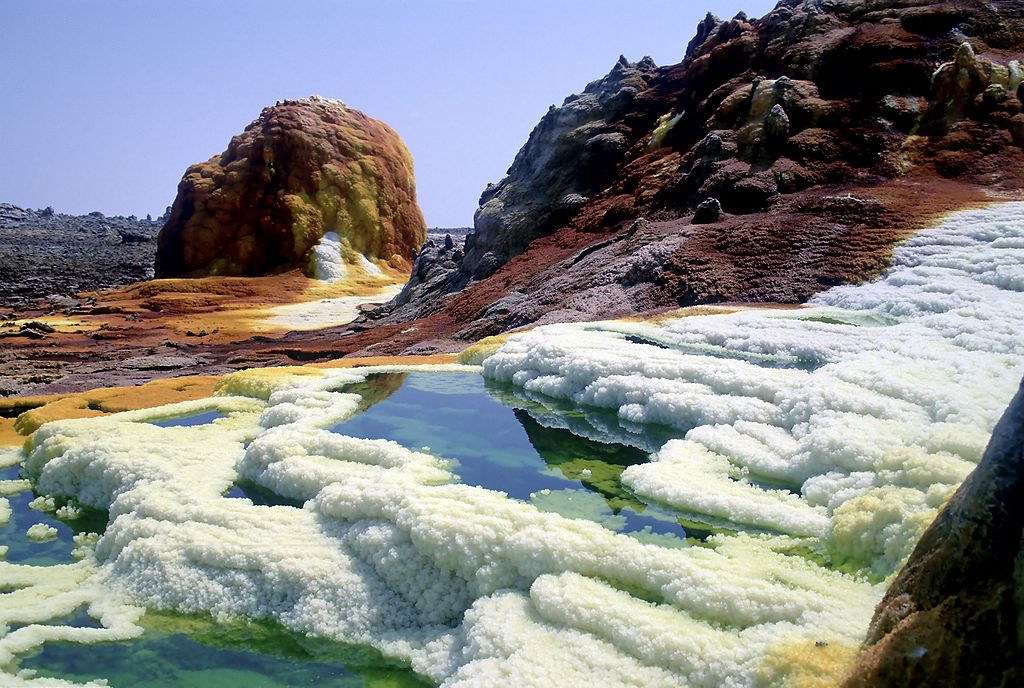
Second country in Africa by population, Ethiopia is the ninth country in the continent by area. Its lands essentially consist of highlands, extending from the Danakil Depression to -120 m to the snowy peaks of Mount Ras Dashan at 4543 m, the country has a very diverse environment crossed by six climatic zones. The capital Addis Ababa, located 400 m above sea level, is the fourth highest capital in the world.
Regarded as the cradle of mankind, Ethiopia is with Chad and Kenya, one of the countries where the oldest hominids were found. Lucy was discovered there in 1974 and in 2003, the oldest specimen of Homo sapiens. The urban phenomenon and the existence of a State there are very old, and the Mesopotamian prophet Mani mentionedthe kingdom of Axum among the four major powers in the world, all that in the third century. In Africa, Ethiopia is characterized as one of the only countries to have maintained its sovereignty during the partition of Africa in the nineteenth century: thus, its colors often symbolize Africa and have been adopted by several other African states, in many different particular ways.
Demographics
In July 2009, according to estimates by the World Factbook19 Ethiopia had a population of 85,237,338 inhabitants, which earned the country the 14th place worldwide and the second in Africa.
The country has experienced a constantly growing and changing demographic trend until early 1980. Thereafter, the growth accelerated to date with an average rate of 2.3% per year, with the exception of a visible decrease between 1992 and 1993 due to the independence of Eritrea, 24 May 1993 whose population at the time was around 3.2 million people. The Ethiopian population is predominantly young and rural, and lives in the highland areas.
Religion
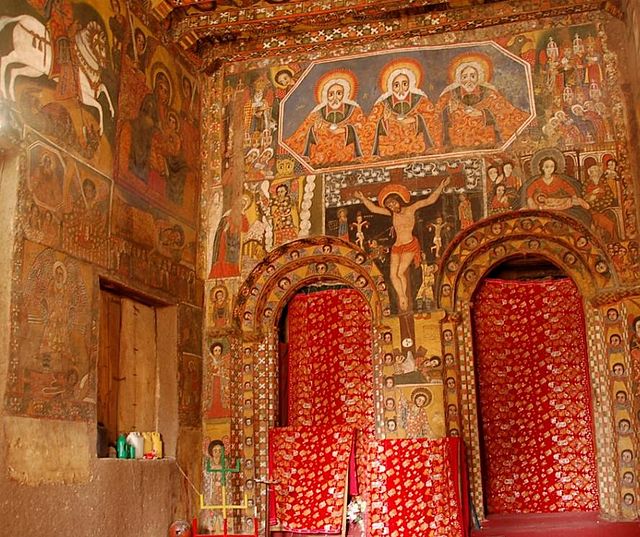 Christianity in Ethiopia is dominated by the Ethiopian Orthodox Church, which is mainly distributed in the highland regions (capital region: Addis Ababa, Amhara and Tigray).
Christianity was introduced to Ethiopia around 330 when St. Frumentius of Tyre, locally called Fremnatos or Abba Selama (“Father of Peace”), converted King Ezana of Axum, making it one of the oldest Christian state in the world the second after Armenia. The cross replaced at this time the symbolism of the Sun and Moon on the parts of the Kingdom.
According to the official national census of 2007, Islam is practiced by approximately 33.9% of the ethiopian population. 
Islam is especially present today in the lower warmer plains of the South and the East, in the regions of Harar, Afar and Somali as well as in parts of southern Oromia region. Islam generally follows the Sunni tradition.
The presence of Islam in Ethiopia dates back to the founding of the Muslim religion. Around 615, a group of Muslims led by Mohammed, fled the persecution they are subject to Mecca, and finds refuge in Ethiopia led then by the Christian king named Ashama ibn Abjar in the Arab tradition.
Food
Ethiopian cuisine is characterized by the use of injera, a pancake made lifting teff used both cutlery and container. Injera is arranged on a large plate in order to place the various stews, sauces and vegetables.Traditionally, the dish is placed on a Messob, a kind of panel made of straw, so that the food can be divided equally.
 The variety Ethiopian desclimats allows to grow a lot of vegetables and starchy foods: millet, maize, barley, lentils, split peas or coriander, which are all basic element for different sauces accompanying injera. The vegetarian dishes are especially consumed during fasting, strictly respected by orthodoxes Christians.
Thee ella is a traditional beer brewed from barley malt, hops and leaves gesho, also used in the manufacture of Tej – sort of mead that often accompanies éthiopiensdishes. Finally, coffee, probably born in Ethiopia, occupies a central place in the culture and traditions nationales37. It is served with a jebena, local coffee, very end of the meal at a ceremony where they burn incense. Coffee beans are roasted on site and did smell them to guests. In most homes, an area lined with grass and equips dedicated furniture is often decorated.
Sports
 Athletics are the most popular sport in Ethiopia, whose runners have won numerous awards in international competitions. Among the Ethiopians dominating the sport in the recent years, there has been Haile Gebrselassie, world champion and Olympic champion, which established more than twenty new world records.
Kenenisa Bekele, world champion cross country and double Olympic champion in Beijing, holds the world record in the 5,000 meters and 10,000 meters category. In women, Tirunesh Dibaba, double Olympic champion in Beijing, is record holder 5000 meters.
Shervin LABANI

 Brussels Diplomatic
You must be logged in to post a comment.