Urban road transport automation in La Rochelle. #transport #larochelle #france #eu
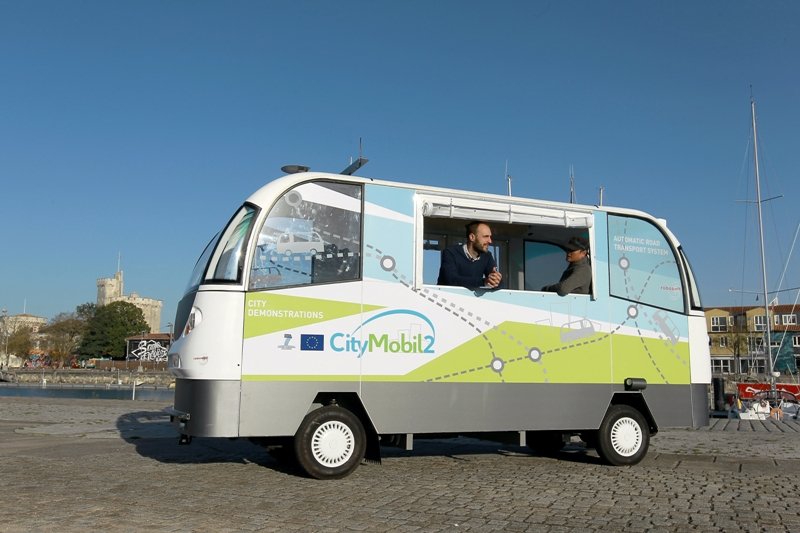
On 30 and 31 March, more than 100 experts from Europe, the US, Japan and Singapore met in La Rochelle (France) to take part in a series of events related to road vehicle automation organised in the context of the European project CityMobil2.
Together with Mr. Jean-François Fountaine, La Rochelle Mayor, Mr. Jean-François Janin, representative of the French Ministry and Mr. Patrick Mercier from the European Commission, international guests were offered the opportunity to ride on the CityMobil2 Automated Road Transport System, which is being demonstrated in La Rochelle since December 2014. It is the first ever fully automated public transport system to share the roads with manually driven vehicles, pedestrian and cyclists.
The week started with a meeting of urban transport stakeholders, notably city authorities and public transport representatives, to debate the role and expectations of cities regarding road transport automation. A number of key issues emerged from this meeting, including urban planning and design and business model: How can cities plan for road automation? How will road automation change the shape of our cities? What type of business model can be developed to deliver road passenger transport automation?
During the subsequent socio-economic impacts workshop, international experts discussed the long-term impacts of road vehicle automation in different urban environments (compact cities, sprawled cities, connected cities and rural areas) and for two different scenarios: the first assuming the dominance of private car automation; whereas the second envisioning a stronger role for automated vehicles operating in shared mode (public transport, car sharing/clubs, etc). The experts were invited to assess the potential impacts of automation on the economy, urban mobility, the environment and society.
The pros and cons of the two caricatural scenarios – automation with and without a paradigm shift to shared mobility – were debated and a number of potential impacts were identified in terms of old jobs (reduction of employment in traditional car making activities), new jobs (creation of new services), personal trips costs, public budget (reduction of fines and parking fee revenues), insurance costs, accessibility enabling the development of remote areas, road capacity and its use, journey comfort and convenience, energy and emissions, land use, new use of public space, social impacts in terms of safety, personal security, health and active travel (automated rides may substitute short distance walking or cycling) and different perception/use of time spent travelling in automated vehicles.
A lively two-day discussion highlighted the revolutionary potential of automation and also pointed out the need for accompanying policies to secure the benefits of automation whilst minimising its potential negative impacts. “There are different market opportunities for exploiting automated vehicles depending on the urban form – automation in densely populated metropolitan areas should exploit the potential advantages of vehicle sharing, while a smart use of automated vehicles in peri-urban towns and rural areas can increase flexibility and reduce car dependency – one car becoming more easily shareable by different members of the household, and reducing the need for a second car”” says Carlo Sessa, Research Director at the Institute of Studies for the Integration of Systems.
A full report of the workshop will be published in May 2015 for the expert and the scientific community at large to comment upon.
The second large-scale demonstration of an automated road passenger transport system was inaugurated on 16 April 2015 at the EPFL campus in Lausanne (Switzerland) in the presence of the presidents of France and Switzerland.
 Brussels Diplomatic
You must be logged in to post a comment.